About the Surgical Technologist Program in Phoenix
Step into the heart of the operating room and train for a career where precision, teamwork, and purpose intersect. At Brookline College’s Phoenix campus, the Surgical Technology program prepares you to become a vital member of the surgical team, supporting surgeons and safeguarding patients during critical procedures. Designed to move you forward with momentum, the program allows you to earn your associate degree in under two years while building the technical skill, confidence, and professionalism today’s employers demand. Through immersive coursework and a supervised clinical externship, you’ll gain hands-on experience alongside experienced surgical professionals in real healthcare settings. As a cornerstone program of the Phoenix campus, Surgical Technology reflects Brookline’s commitment to career-focused education, equipping you to graduate ready to step into entry-level roles in hospitals, clinics, and trauma-care environments with confidence.
HYBRID LEARNING
Learn through a flexible blend of online coursework and hands-on lab training, helping you build real-world skills while balancing school and life.
96-WEEK ACCELERATED PROGRAM
Complete your training in as few as 96 weeks and take the next step toward a fast-moving, in-demand healthcare career.
CAREER-FOCUSED TRAINING
Phoenix ST Graduate Placement Rate
84%
View all
What You’ll Learn
At Brookline College’s Phoenix campus, the Surgical Technology program prepares you to become a confident, capable presence in the operating room. Designed to reflect the realities of surgical care, the program combines hands-on training with real-world clinical exposure so you can develop the skills and professionalism required to support surgeons and safeguard patients during procedures. You’ll learn in modern simulation labs using current surgical technology, guided by experienced faculty who bring operating-room insight into every lesson. A supervised clinical externship further strengthens your readiness, allowing you to experience the Surgical Technologist role firsthand in active healthcare settings. By graduation, you’ll be prepared for entry-level employment as a Surgical Technologist and supported in completing a nationally recognized certification exam during your externship course, though certification is not required to graduate.
Set up and organize operating rooms with the instruments, supplies, and equipment required for each procedure
Apply sterile technique and maintain a controlled surgical environment before, during, and after operations
Support surgeons and nurses by passing instruments and managing surgical materials throughout procedures
Follow safety protocols that protect patients and ensure compliance with operating room standards
Stay attentive and responsive to the changing needs of the surgical team in high-pressure settings
Collaborate professionally within a surgical team to promote efficiency, communication, and patient care
Follow these simple steps to start your path toward becoming a Surgical Technologist.
Meet with admissions
(virtual or in-person)
Enroll
Begin the enrollment process.
Submit your documents
Submit a copy of a government-issued ID and proof of high school diploma/GED.
Submit transcripts
Submit any previous college transcripts for free evaluation.
Take and pass SLE-Q entrance exam
(in-person)
Complete FAFSA
Complete FAFSA and Financial Aid appointment.
Start classes
Begin your scheduled classes.
For a list of all admissions steps and requirements, please visit the college catalog.
Curriculum Overview
The Surgical Technology curriculum at Brookline College’s Phoenix campus is designed to prepare you for the precision, pace, and responsibility of the operating room. Through a structured blend of classroom instruction and hands-on learning, you’ll develop the technical knowledge and professional awareness required to support surgical teams effectively. The program also includes a supervised clinical externship, giving you the opportunity to apply your skills in real surgical settings and gain firsthand experience before graduation.
Core ST Subjects
Anatomy
Physiology
Introduction to Surgical Technology
Surgical Techniques
Medical Terminology
My fascination with surgery and the intricacies surrounding it drove me to pursue Surgical Technology. The prospect of making a difference in people’s lives appealed to me, and when I learned about the program at Brookline, I knew it was the right choice for me.
Hannah A.Brookline College Graduate
I've always been drawn to the educational side of surgery. When transitioning from the Operating Room, Brookline was my top choice. Their potential to be Arizona's leading Surgical Technology program impressed me.
Pamela H.Brookline College Graduate
The Phoenix Campus
Designed to reflect the pace and professionalism of today’s healthcare environments, Brookline College’s Phoenix campus offers a dynamic setting for Surgical Technology students to learn, practice, and grow. You’ll train in modern classrooms and simulation labs that mirror real operating rooms, supported by an updated campus library and collaborative study spaces that encourage focus and connection. An open quad area provides a welcoming place to recharge between classes, connect with peers, or enjoy Arizona’s year-round sunshine. Located in the heart of Phoenix, the campus places you near local dining, coffee shops, and transit options, while remaining well connected to hospitals and surgical facilities throughout the greater Phoenix area, putting both your education and future career within reach.
Hybrid Learning
The Surgical Technology program in Phoenix uses a hybrid learning format that blends flexible online coursework with hands-on, in-person training. Online learning allows you to build a strong foundation in key concepts such as anatomy, surgical procedures, instrumentation, and aseptic technique, while also giving you the ability to review and reinforce complex material at your own pace. This coursework is intentionally designed to prepare you for success in the skills lab, ensuring you arrive with the knowledge and terminology needed to fully engage in hands-on practice. By shifting foundational learning online, more time in the lab is dedicated to developing technical skills, helping you maximize real-world training and readiness for the operating room.
Skills Labs
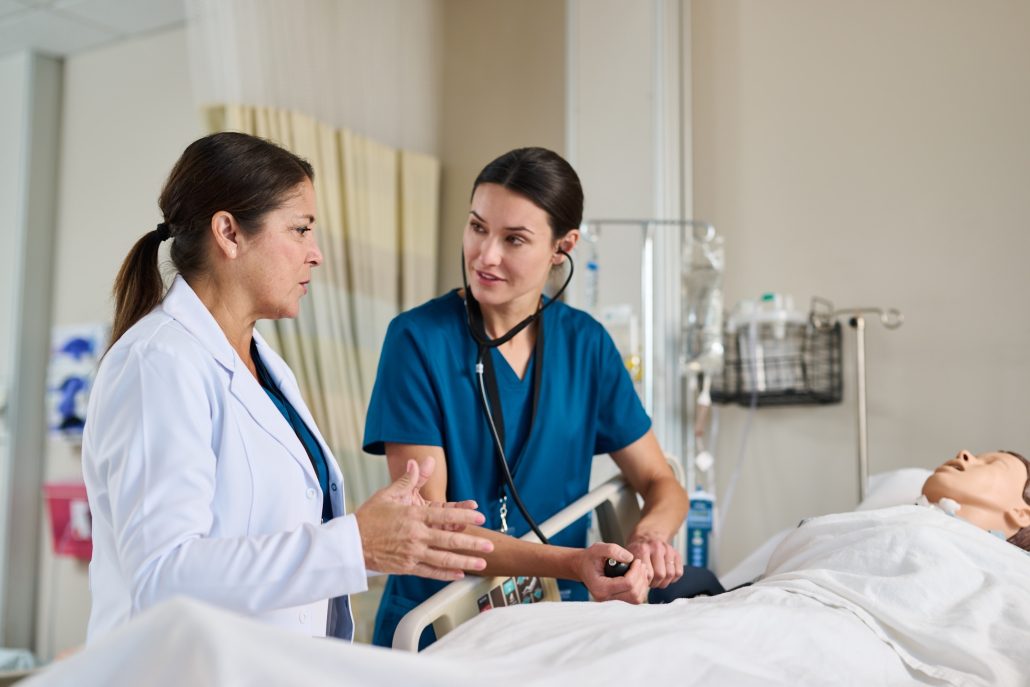
In skills labs, you’ll train in environments designed to replicate a functioning operating room, complete with OR tables, surgical lighting, back tables, Mayo stands, instrumentation, and sterile supplies. Using surgical mannequins and task trainers focused on procedural skills, you’ll practice sterile technique, gowning and gloving, instrument handling and passing, patient positioning and prepping, as well as surgical counts and setup. This hands-on approach emphasizes real OR workflow rather than patient assessment, allowing you to build muscle memory, reinforce safety and accuracy, and gain confidence through repeated practice in a controlled, risk-free setting before entering clinical environments.
Campus Location
Conveniently positioned near Phoenix Sky Harbor International Airport and the Valley Metro Light Rail system, Brookline College’s Phoenix campus offers exceptional accessibility for students commuting from across the South, West, and East Valley. Located along South Priest Drive, the campus is well connected to major roadways and public transit, making it easier to balance school with work and daily life. Inside, you’ll find modern classrooms and advanced simulation labs designed to reflect real healthcare environments, giving you the opportunity to train in spaces that mirror the pace, technology, and professionalism of the settings you’ll encounter as you step into your career.
The Surgical Technology program at Brookline College’s Phoenix campus can be completed in as little as 96 weeks, allowing you to move efficiently toward an entry-level role in surgical healthcare while receiving comprehensive training.
Tuition varies by program and individual enrollment details. Your Admissions Representative will review tuition, estimated fees, and available financial aid options during the admissions process so you can plan with confidence.
Students who qualify may be eligible for federal grants, student loans, scholarships, and other funding opportunities. Our Financial Aid team works closely with you to explore options aligned with your goals.
We recommend completing the FAFSA as early as possible, ideally before your program start date in order to ensure timely access to available funding.
Yes. The program is designed to prepare graduates to sit for a nationally recognized Surgical Technology certification exam. Students receive support in completing the exam during the externship portion of the program.
Arizona requirements may vary by employer. Many employers prefer or require certification. Admissions can provide general guidance on certification expectations and employment pathways.
The Phoenix campus serves students from across the greater Phoenix metropolitan area, including the South, West, and East Valleys. Many students commute from nearby communities such as Chandler, Gilbert, Mesa, Scottsdale, Paradise Valley, Fountain Hills, Glendale, Peoria, Goodyear, and El Mirage.
Yes. Students participate in a supervised clinical externship that provides hands-on experience in real surgical settings within the region.
Students have access to academic advising, tutoring, faculty support, financial aid counseling, career services, and student success resources throughout the program.
Career Services may assist with résumé development, interview preparation, and job-search guidance to support your transition into entry-level Surgical Technologist roles.
Graduates are prepared to pursue entry-level roles in hospitals, outpatient surgery centers, specialty clinics, urgent care facilities, and other surgical healthcare settings.
The Surgical Technology program at Brookline College’s Phoenix campus can be completed in as little as 96 weeks, allowing you to move efficiently toward an entry-level role in surgical healthcare while receiving comprehensive training.
Tuition varies by program and individual enrollment details. Your Admissions Representative will review tuition, estimated fees, and available financial aid options during the admissions process so you can plan with confidence.
Students who qualify may be eligible for federal grants, student loans, scholarships, and other funding opportunities. Our Financial Aid team works closely with you to explore options aligned with your goals.
We recommend completing the FAFSA as early as possible, ideally before your program start date in order to ensure timely access to available funding.
Yes. The program is designed to prepare graduates to sit for a nationally recognized Surgical Technology certification exam. Students receive support in completing the exam during the externship portion of the program.
Arizona requirements may vary by employer. Many employers prefer or require certification. Admissions can provide general guidance on certification expectations and employment pathways.
The Phoenix campus serves students from across the greater Phoenix metropolitan area, including the South, West, and East Valleys. Many students commute from nearby communities such as Chandler, Gilbert, Mesa, Scottsdale, Paradise Valley, Fountain Hills, Glendale, Peoria, Goodyear, and El Mirage.
Yes. Students participate in a supervised clinical externship that provides hands-on experience in real surgical settings within the region.
Students have access to academic advising, tutoring, faculty support, financial aid counseling, career services, and student success resources throughout the program.
Career Services may assist with résumé development, interview preparation, and job-search guidance to support your transition into entry-level Surgical Technologist roles.
Graduates are prepared to pursue entry-level roles in hospitals, outpatient surgery centers, specialty clinics, urgent care facilities, and other surgical healthcare settings.
Get started today!
Complete this form and our Admissions department will contact you shortly with more information.
*These placement rates are based on program-specific and campus-specific data reported to our institutional accreditor(s) in 2024. While the figures shown here are not separately reported to our accreditor, they are derived from those outcomes. For full details by program and campus, please visit our Disclosures page.
*Please note that wage data provided by the Bureau of Labor Statistics (BLS) or other third-party sources may not be an accurate reflection of all areas of the country, may not account for the employees’ years of experience, and may not reflect the wages or outlook of entry-level employees, such as graduates of our program (accessed on 3/17/2026).